A product finder should reduce uncertainty before purchase. If it asks five questions and then displays the same bestseller regardless, it has mostly added work. For someone arriving through a ChatGPT ad, every question should have a clear role in the task the ad offered to help with.
This guide concerns a finder on the advertiser’s own website. It may be a straightforward question flow using fixed rules. It does not need to be presented as an AI feature, and it should not pretend to know the visitor’s earlier conversation. Let the person provide the information required for the choice.
Start with decisions, not a questionnaire
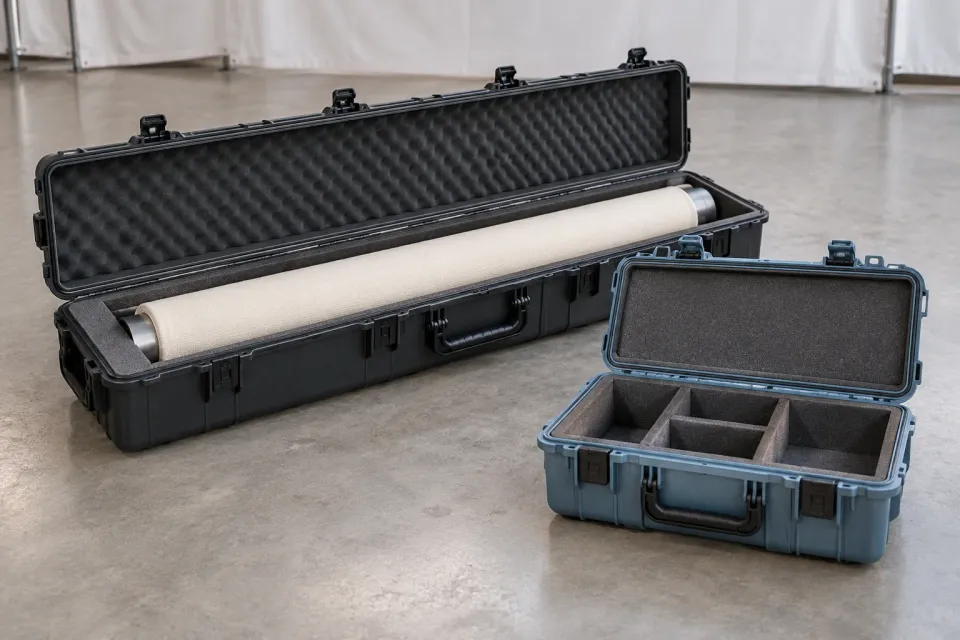
Imagine a hypothetical retailer advertising transport cases for exhibition materials. Its range has different internal dimensions, empty weights and compartment arrangements. Before writing questions, identify which properties distinguish a usable option from an unsuitable one.
List firm requirements first. If an object does not fit inside a case, its colour or price is irrelevant to that task. Then list tradeoffs, such as lower empty weight against more fixed compartments. This establishes which answers should exclude products and which should influence the presentation of the remaining options.
Check whether the catalogue can support those rules. If internal measurements are missing for a model, the finder cannot responsibly treat it as a confirmed match. Obtain the information or carry the uncertainty into the outcome.
Ask for information the customer can provide
A technical product attribute is not automatically an understandable question. The buyer may know the length of their longest object without knowing which case series is commonly used for exhibitions. Ask for things they can observe, measure or reasonably decide.
For the cases, ask about the longest item and provide a short measurement explanation with a clear unit. If packing material requires additional room, describe that assumption. Do not ask the buyer to invent an exact allowance the retailer has not defined.
Keep each question to one decision. Asking whether the materials will travel frequently and need to be lightweight combines frequency with a weight preference. Two customers may give the same answer for different reasons. Split the question if both facts affect the result, or ask only for the fact the rule actually needs.
Give uncertainty its own route
An I do not know option is useful only when the flow handles it honestly. If the buyer does not know the object’s dimensions, offer measurement help, a way to return later or a contact route. Do not interpret a missing answer as confirmation that every size works.
Distinguish information the customer prefers not to provide from information they do not have when that difference matters. An optional budget question can be skipped, leaving a broader price range. A necessary fit requirement may need an answer before describing a product as suitable. Explain the distinction without blaming the visitor.
When the choice involves connections or existing equipment, investigate compatibility using the relevant evidence. A broad use-case answer such as exhibitions cannot replace the identity of a component the product needs to work with.
Make the rules understandable to the team
Write each rule as a condition and consequence. If the object’s length exceeds the case’s usable internal dimension, exclude the case. If the customer prefers low weight, present the remaining choices with comparable empty weights. These are different kinds of rules and should be reviewable separately.
Avoid a hidden total score that mixes physical fit, price and the retailer’s margin. If commercial prioritisation affects the order, be able to explain it without calling it the best personal match. An explicit customer requirement should not disappear into a score that looks more precise than its evidence.
Ordinary product filters may provide a simpler route for buyers who already know the required attributes. A finder adds value when it explains the questions or translates a task into a selection. Retain a direct route to filters for an experienced buyer.
Show the reasoning behind the result
Display the answers used and explain why each suggested product appears. For a transport case, that could mean internal dimensions accommodating the stated item and a compartment layout the buyer preferred. Separate confirmed requirements from preferences and outstanding checks.
When several products fit, explain their tradeoffs instead of declaring an unsupported winner. When none fits, identify the uncovered requirement. Let the buyer change an answer without restarting the entire flow because one measurement needs correction.
Connect the outcome to the product page. A selected size should remain identifiable after the click, and the customer should be able to inspect dimension diagrams showing the space involved. The finder should not become the only place holding essential product information.
The finder needs an uncertain outcome
- Requirement met
The documented internal dimensions accommodate the stated item.
- Requirement not met
Explain which dimension excludes the case.
- Measurement missing
Explain how to measure before recommending a purchase.
- Several possible
Compare weight, compartments and price as explicit tradeoffs.
Test the boundaries before using the ad
Try an object that clearly fits, one that clearly does not and one at the boundary your rule defines. Add a missing answer, conflicting answers and a product record that recently changed. Write the expected outcome before running each case, so a plausible-looking result is not mistaken for a correct rule.
OpenAI documents the ad destination in Campaign Management. Inspect the actual route from your own creative: can the buyer understand what the finder helps with, reach products directly and recognise the ad promise in the language of the result?
Finally, assign responsibility for the rules when the assortment changes. New cases, revised measurements and withdrawn variants can make an earlier result incorrect. A small, explained finder with maintained rules is more useful than a lengthy questionnaire whose conclusion nobody can account for.
Sources and scope
Design questions, selection rules and explained outcomes in an advertiser-owned product finder, including uncertain answers and cases where no product meets the requirement.
Working methods and examples are editorial suggestions. Check current platform requirements and available features before implementation.