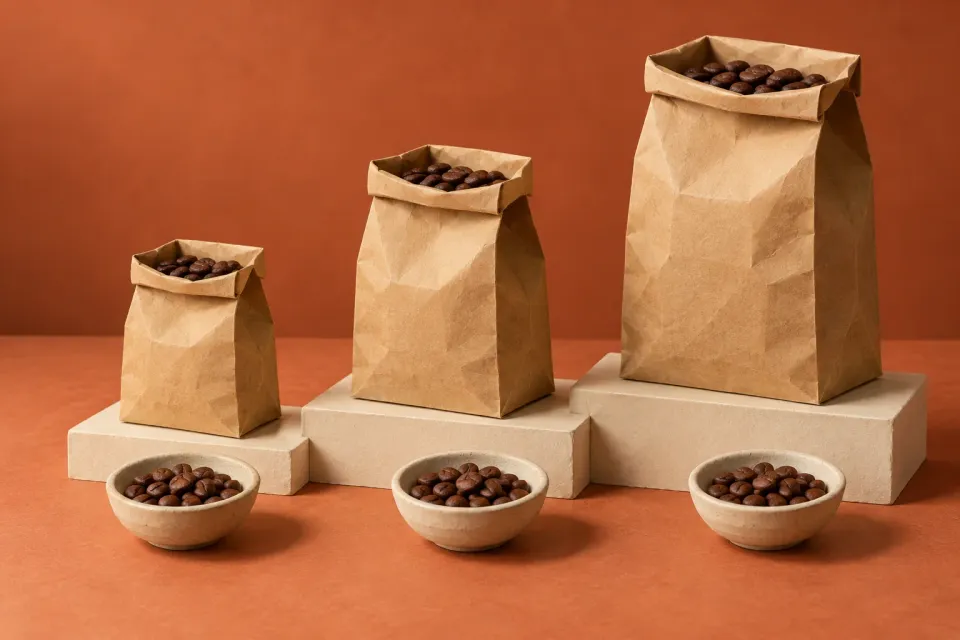
Three packages can look inexpensive for three different reasons. One has the smallest price tag, another seems a convenient size, and the third has the lowest price per kilogram. When a paid ChatGPT ad leads to these choices, customers need a common basis for comparison. Placing a large number beside a small one is unhelpful when the amounts refer to different quantities.
This guide assumes the customer understands the package. If the destination first needs to explain what its quantity selector means, begin with pack size and order quantities. The decision here comes afterwards: what does a comparable amount cost, and what does the order that meets the customer’s requirement cost?
One example, three different price questions
The following hypothetical calculation uses the same coffee beans in three package sizes. All prices are in Swedish kronor and use the same price basis. Shipping is excluded. These figures describe no real offer or observed customer behaviour.
| Package | Price for one package | Price per kilogram |
|---|---|---|
| 500 grams | SEK 129 | SEK 258/kg |
| 1 kilogram | SEK 219 | SEK 219/kg |
| 2 kilograms | SEK 398 | SEK 199/kg |
The two-kilogram package has the lowest price per kilogram. The half-kilogram package has the lowest amount payable for one package. Neither answer alone determines the most suitable purchase. The normalized price describes cost on a shared quantity basis; it is not automatically the amount charged at checkout.
Display both prices with their units. “SEK 199/kg; package price SEK 398” makes the relationship understandable. A standalone “SEK 199” could suggest that the complete two-kilogram package costs that amount. The explanation belongs beside the choice, not only in a general pricing note elsewhere on the page.
Choose the denominator before designing the display
A useful comparison unit represents something customers can meaningfully compare. Weight suits the coffee example. Volume may suit the same kind of liquid, while item count may suit identical replacement components. Number of packages is a poor basis when those packages contain different amounts.
Calculate the unit price from the sellable quantity. In the example, 129 divided by 0.5 gives SEK 258 per kilogram. Convert quantities to the same unit before calculating and rounding the display. A gram amount and a kilogram amount cannot be treated as directly comparable numeric values.
Similar products are not always economically interchangeable. Two concentrates may require different doses, and consumable components may have different documented service lives. A cost-per-use comparison needs to disclose its assumptions. An invented standard number of uses makes the comparison uncertain even when the arithmetic itself is correct.
Where alternatives also differ in function, use a product-model comparison table. Price can then appear as one clearly defined row among verified differences. Do not treat the lowest normalized price as evidence that one alternative is best for every customer.
The required order can change the apparent winner
Suppose, hypothetically, that the customer needs at least 1.2 kilograms. All three sizes are available and may be combined in one order at the listed prices, without quantity discounts. Include mixed orders in the comparison:
| Order | Quantity | Product cost | Surplus |
|---|---|---|---|
| 1 × 1 kg + 1 × 500 g | 1.5 kg | 219 + 129 = SEK 348 | 0.3 kg |
| 3 × 500 g | 1.5 kg | 3 × 129 = SEK 387 | 0.3 kg |
| 1 × 2 kg | 2 kg | SEK 398 | 0.8 kg |
| 2 × 1 kg | 2 kg | 2 × 219 = SEK 438 | 0.8 kg |
With these sizes and prices, the mixed order meets the requirement at the lowest product cost: SEK 348. It costs SEK 39 less than three half-kilogram packs for the same quantity. The lowest unit-price package therefore does not give the cheapest order. Shipping remains excluded.
That does not make the large package a poor choice. The customer may want extra coffee and be able to use it. However, the destination should distinguish low cost per kilogram, low order total and little surplus quantity. These are different priorities for the customer to weigh.
If your shop offers a quantity calculator, consider permitted combinations and show the required packs and surplus. If mixed orders are prohibited, disclose that restriction before the result. Keep estimated consumption separate from actual package contents. Place the assumed requirement beside the result so a customer can change it when their situation differs.
Lowest on different measures
- Lowest package price
500 g costs SEK 129, but one package does not meet the requirement.
- Lowest price per kilogram
2 kg costs SEK 398, equivalent to SEK 199/kg.
- Lowest purchase amount for the requirement
1 × 1 kg + 1 × 500 g supplies 1.5 kg for SEK 348, with 0.3 kg surplus.
Keep the pricing condition attached to the number
A multipack offer, membership price or volume threshold can change the comparable price. Explain which condition is required for the displayed calculation. Where the price depends on buying two packs, do not present it as the unconditional cost of buying one.
Also decide how the comparison treats shipping. A product price per kilogram and an order total including delivery can both be useful, but they answer different questions. Identify costs that cannot yet be determined. Avoid a seemingly exact final total when the customer has not selected the destination or delivery method needed to calculate it.
Use the same currency and price basis for alternatives displayed together. This is an editorial method for understandable comparisons, not an account of price-labelling rules in a particular market. Review the actual pricing information with the person responsible for your product range and sales conditions.
The broader product-feed guide covers the catalogue preparation that supports this price review.
Review the advertised item and the calculation together
OpenAI says product prices should remain current in Product Feeds. Ad destinations are documented in Campaign Management. The resulting editorial task is concrete: open the link and compare the price for the same sellable item with the advertising source information.
The unit price on your destination needs recalculating whenever the package price or quantity changes. Updating only the description can leave an old kilogram price behind. Updating only the calculator can leave an old package amount on a listing card. See product-card decision information when customers encounter the comparison before reaching the full product page.
Finally, try an ordinary package, another size and an option with a pricing condition. Ask the reviewer to read out the amount actually payable for the selected quantity. If they answer with the normalized price, the distinction needs clearer wording. Record the formula’s quantity basis and the responsible price source so the next update can be checked without reconstructing the entire calculation.
Sources and scope
Choose a meaningful common price basis across product packages and distinguish a normalized comparison price from the cost of the order a customer needs.
Working methods and examples are editorial suggestions. Check current platform requirements and available features before implementation.