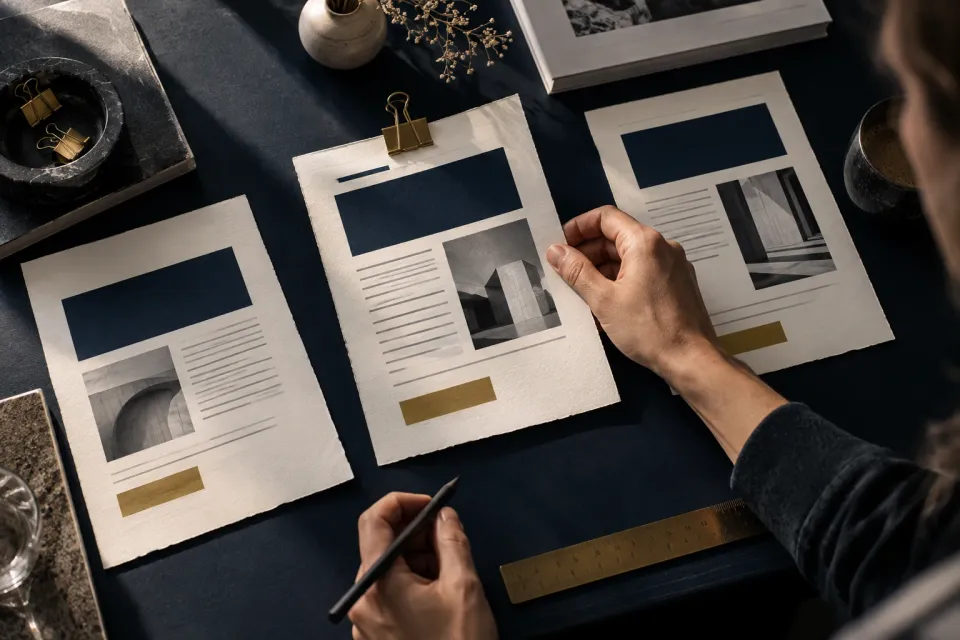
The first screen of a landing page has a small but important job: help someone decide whether they have reached the right place. It cannot explain an entire service, answer every objection and introduce every team member. Trying to do all three usually produces a headline that sounds impressive while leaving the actual offer unclear.
For a visitor arriving from a ChatGPT ad, start with the advertised offer and write the page opening as its continuation. OpenAI’s campaign management documentation includes a landing-page URL within the ad creative. The writing choices below are editorial recommendations for that destination, not a platform formula or a promise of better results.
Suppose your ChatGPT ad promotes an acoustic assessment, but its destination opens with the company’s broad office-design message. The immediate work is to connect that particular ad to the assessment opening, not to rewrite every page on the website. Keep a small review sheet containing the ad’s offer, its destination heading and its button label. If the ad says “Explore an assessment” while the button says “Buy furniture”, resolve the mismatch before using the destination. Review each materially different ad offer separately; changing the first screen to satisfy one ad can make another ad’s destination less relevant.
Write the offer in ordinary language first
Before arranging the page, complete this sentence privately: “We provide this deliverable, for this kind of situation, through this next step.” If the team cannot agree on the deliverable, a more polished headline will not resolve the disagreement.
Consider a fictional company selling workplace acoustic assessments. “Make room for better work” might describe its aspiration, but the visitor cannot tell whether the company sells furniture, rents offices or provides consulting. “Acoustic assessments for open-plan offices” identifies the service. A supporting sentence can explain that the assessment reviews the room and provides recommendations, provided those are real parts of the service.
Do not force every qualification into the headline. Put the most decisive one in supporting text. If the service is available only in a particular region, that boundary may matter more than a broad adjective such as professional. If the company works remotely with submitted measurements, explain that instead.
Give each element a separate job
A useful opening can contain four elements without becoming crowded. The heading identifies the offer. Supporting copy establishes who it suits and what is included. A short evidence item substantiates one important claim. The button names the immediate action.
| Element | Draft for the fictional assessment service | What to verify |
|---|---|---|
| Heading | Acoustic assessments for open-plan offices | This is an actual service |
| Supporting text | Get a review of your room and a written recommendation | Both deliverables are included |
| Evidence | View an anonymised sample report | The sample is representative and permitted |
| Button | Request an assessment quote | The next screen requests a quote, not payment |
The table is a writing exercise, not ready-made claims for any business. Change each line to match the real operation. In particular, avoid implying that a request produces a confirmed booking when someone must still review availability.
From advertised assessment to a clear enquiry
- The ad
Acoustic assessment for offices.
- The opening
Explain the review and written recommendation.
- The action
Request a quote without implying a booking.
Keep the qualification when the headline wraps
A shorter mobile heading can be more concentrated while retaining the offer’s meaning. Removing “remote” may make someone expect a visit. Moving “for open-plan offices” much further down may imply that the service covers spaces it was never designed for. Remove decorative language before deleting information that changes what the customer receives.
Read image captions and badges alongside the heading too. A “complete solution” badge can widen the promise even when the supporting text describes a limited assessment. Review the opening as one offer, including elements written by different people.
Decide what the image contributes
The largest image should help explain the offer or establish the context. For the assessment service, a photograph of a real room inspection may be useful if it accurately reflects the work. A sample report image could be more informative when the main uncertainty is what the customer receives.
An abstract image of smiling colleagues may provide atmosphere, but it does not explain the assessment. Treat that as a deliberate choice rather than assuming the image is evidence. Make sure essential information also exists as text so it does not depend on reading a screenshot.
On a phone, inspect whether the image pushes the offer and action far apart. There is no universal requirement that every element fit above one fixed fold. Screens, browser controls and text settings differ. The practical question is whether the sequence remains understandable before someone starts exploring.
Remove competing promises
A common draft contains a primary offer, a newsletter invitation, a free download, a chat prompt and an unrelated promotion in the same opening. Each can be useful somewhere, but together they make the page’s purpose harder to identify.
Choose the next step that matches this destination. Keep a secondary route when it serves a real hesitation, such as viewing the sample report before requesting a quote. Give that route less visual weight and a descriptive label. Do not hide useful navigation merely to force a conversion. A visitor who needs background should still be able to find it.
Read the guide to secondary actions when the page needs a route for people who are interested but not ready to enquire. The guide to sample deliverables covers the evidence behind the sample-report link.
Review the opening without its design
Copy the heading, supporting text and button into a plain document. Ask someone unfamiliar with the offer to describe what they would receive and what happens after pressing the button. Their answer is more useful than asking whether they like the headline.
If they describe a different service, identify the word that caused the confusion. If they cannot predict the next step, make the action more specific. If they assume a price, response time or guarantee that the business has not offered, remove the implication.
Finally, review the same text inside the actual page on a narrow screen, with larger text and with the image unavailable. Check that the heading is still complete, the button is not truncated and any important qualification stays near the offer. Publish the version that accurately explains the service. Treat later changes as hypotheses to assess with real enquiries and visitor feedback, rather than declaring that a particular headline structure always wins.
Sources and scope
The heading, supporting copy and action on the first screen reached from a specific ChatGPT service ad.
Working methods and examples are editorial suggestions. Check current platform requirements and available features before implementation.