| Vague draft | A more concrete direction |
|---|---|
| Make work better | Book a workspace for your recurring office day |
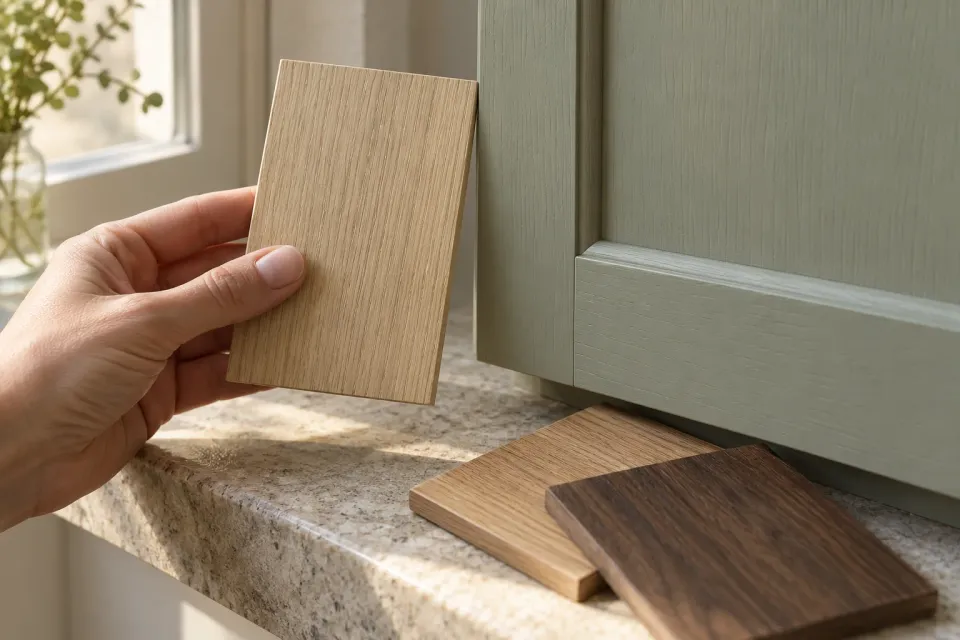
| Discover endless possibilities | Compare cabinet finishes with a material sample |
| Take your team to the next level | Plan a workshop around your team’s current project |
The second column is not a list of proven winning ChatGPT headlines. These are fictional rewrites showing a practical difference: a reader can identify the offer. Each sentence would still need checking against the business that wants to use it.
A headline does not need to explain the whole campaign. It needs to lead with a proposition that the rest of the ad can support. That is a narrower and more useful task than trying to sound exciting to everyone.
Find the missing noun
Look at a draft and underline the object being offered. If all you can find is “solutions”, “possibilities”, “success” or “the future”, the sentence may be hiding the actual offer. Ask what the customer can inspect, request, book or purchase.
For a workshop provider, that might be a facilitated planning session. For a manufacturer, it might be a material sample. For a software business, it might be a specific workflow or demonstration. The answer gives the headline a concrete centre.
Do not automatically put the full product name in that position. An unfamiliar internal name may be less informative than the category and task. A named feature can work when the reader understands it or when the supporting copy makes its role clear. Otherwise, lead with the thing it helps the customer do.
Try writing a deliberately plain version first: “Request a sample of the cabinet finish.” Once the meaning is sound, decide whether the wording needs more character. It is easier to improve a clear sentence than to recover meaning from a slogan that contains no identifiable offer.
From slogan to visible offer
- Vague draft
Discover the possibilities does not identify what the customer receives.
Reconsider - The concrete item
A material sample gives the offer an identifiable object.
- Headline direction
Compare a finish with a sample, if that is what the offer supplies.
Checkpoint
Choose one detail that matters
Specificity is not a competition to fit more facts into the headline. Pick the detail that helps this buyer distinguish the offer. A sample’s material, a workspace’s booking pattern or a workshop’s focus may matter more than the company’s age or the product’s colour.
Use the customer brief to make the choice. If the main uncertainty is whether a finish matches an existing cabinet, a physical sample is relevant. If the uncertainty concerns installation, the sample may not answer it. The headline should follow the selected decision rather than accumulating every available benefit.
Consider a fictional acoustic consultation. “A room assessment with a written recommendation” describes a deliverable if the service includes it. “Better sound, happier teams, faster meetings” piles up outcomes with very different evidence requirements. Even if the business believes in those benefits, the headline has become difficult to substantiate.
Write several directions that change the emphasis, not just the adjectives. One can lead with the deliverable, another with the task and another with a verified constraint. Review which one belongs to the actual campaign brief. Do not call cosmetic variants different concepts when they make the same proposition.
Watch what editing adds
A headline can become less accurate as it becomes shorter. “Review the available appointment times” turning into “Get an appointment today” adds an availability promise. “A guide for preparing your files” becoming “Ready-to-print files” changes the deliverable. Shortness does not justify those shifts.
Mark the words that carry scope. “Selected”, “introductory”, “optional” and “supported” can be essential. If removing one changes who receives the offer or what they receive, find a different way to write the sentence. Do not simply move the condition out of sight and hope the body compensates.
Also inspect verbs. “Explore”, “compare”, “request” and “book” describe different commitments. “Book” can imply that the next action reserves something, while “request” may describe an enquiry requiring a reply. Choose the action the advertiser actually offers at this step.
For a factual review, use the claim evidence matrix. Its job is to check the promise. This headline exercise decides which supported promise deserves the reader’s first attention.
Read the finished ad as one statement
Place the selected headline beside the actual body copy and image. A precise phrase can still become ambiguous in combination. “Choose your finish” beside a complete kitchen might look like an offer for a whole installation, even if the campaign is promoting sample swatches.
Ask someone unfamiliar with the brief what they think happens next. Their interpretation identifies possible ambiguity, not a guaranteed prediction of all readers. If the answer differs from the intended offer, revise the combination rather than defending the headline in isolation.
Use the preview in your advertising workflow to inspect the assembled creative. OpenAI’s campaign management documentation describes the preview workflow. Appearance checks complement the editorial review; they do not prove that a headline will perform well.
Before handing over the final version, keep one sentence explaining why it was chosen: “Leads with the physical sample because the brief concerns matching an existing surface.” That reason is more useful for future revisions than “sounds stronger”. Revisit the interview-to-message process if the customer decision is still unclear, and review the image’s own claims when the visual changes the meaning.
Sources and scope
Editing the headline of a ChatGPT ad so it communicates one concrete, supported proposition.
Working methods and examples are editorial suggestions. Check current platform requirements and available features before implementation.