A business selling prototype design needs to explain what the client can decide after the engagement. “From idea to finished product” may sound attractive in a ChatGPT ad, but it overstates a package that ends with a mockup and a meeting. The buyer needs to understand which evidence will actually be ready before committing money to manufacturing.
Plan the ad around a question the service can investigate: can someone replace the card, does the object fit on the counter or does the intended opening work? The prototype is one part of the deliverable. Notes, limitations and unresolved questions make the result useful for the next decision.
Choose the uncertainty the engagement addresses
The following example is fictional. A design studio helps a retail chain develop a reusable price-card holder for checkout counters. Staff should be able to replace the card without moving the entire holder. The advertised package includes one selected approach to card replacement, a physical test model and a documented client review.
The engagement therefore starts with the card-changing task rather than every aspect of a new retail product. The client supplies card dimensions and placement examples. The studio states what the model represents, who will try it and which observations will be recorded.
That precision gives the ad a concrete offer. “Investigate card replacement before the next design decision” describes bounded work. It communicates more than “innovative prototypes” without promising a finished manufacturing solution.
Distinguish four deliverables in the brief
Use the following distinctions for the fictional engagement. They are a working model for this offer, not a universal standard for design projects.
| Deliverable | Decision it supports here | What it does not establish |
|---|---|---|
| Concept sketches | Which card-changing approach should be explored? | Whether the mechanism works physically |
| Mockup | How large should the holder be on the counter? | The finished product’s service life |
| Testable prototype | Can the selected card-changing task be completed under the test plan? | Readiness of the whole design for manufacturing |
| Manufacturing release package | Which defined version should the manufacturer assess? | Automatic acceptance of every future unit |
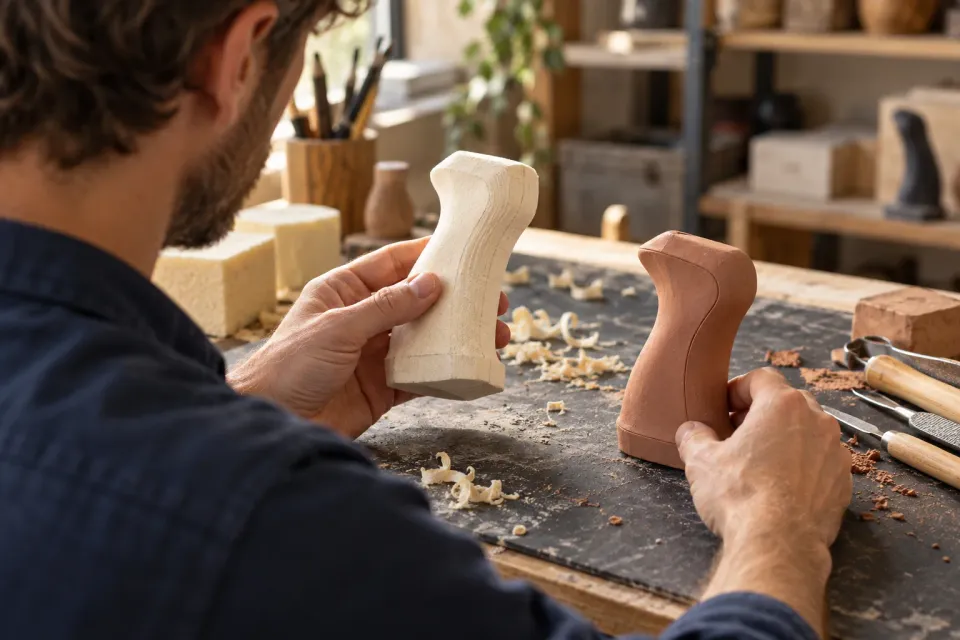
If the studio sells only the third row, the advertising needs to preserve that scope. A photograph of a finished-looking model can otherwise suggest more than the service description. Label illustrations and examples with the question the model was made to investigate.
What decision can the deliverable support?
- Concept
Choose a card-changing approach. Selecting an idea does not establish that its mechanism works.
- Mockup
Review size on the counter. The material does not represent final durability.
- Testable prototype
Try card changes against a test plan and record what remains unresolved.
- Manufacturing release
Requires a separate review of drawings, materials, process and responsibility.
State what the prototype represents
A test model might have the intended dimensions but use a different material. An opening might have been adjusted by hand. Its colour might have been selected for photography. Record those differences so the client does not interpret every visible property as a settled product decision.
For the card holder, the studio could make the model represent the card’s insertion path and the space available for a person’s hand. Surface finish, cleaning and manufacturing cost sit outside this advertised package. Those are choices in our fictional offer, not statements about the capabilities of all prototypes.
Explain the boundary in a few direct sentences. An exhaustive list of everything the studio does not do is unlikely to help the ad reader. The buyer needs to understand what the investigation concerns and what work remains afterwards.
Include the record of the findings
Define what the client receives when testing finishes. Here, it could be a versioned model, the test question, observations from card changes and a list of recommended alterations. Separate observed behaviour from the designer’s interpretation in those notes.
A useful result does not require the model to succeed. If cards jam, the deliverable can still identify where the design needs revision. The ad should promise the investigation and its documentation rather than a favourable result that does not yet exist.
If the client wants another model after the review, make clear whether that iteration is included. Use the guide to service scope in hints to distinguish the core package from additional work. “Prototype development” should not conceal an unspecified number of revisions.
Assign responsibility for the manufacturing decision
Recorded approval against agreed test criteria covers only the solution and version examined. It does not establish that somebody has approved the material, dimensional specification or manufacturing process. Identify who will assemble and review the information before a manufacturer uses it.
In this example, the studio delivers unresolved design questions alongside the model. A later engagement may cover drawings and discussions with a manufacturer. That engagement needs its own scope. Do not write “production-ready” in the first ad simply because the studio can also provide later services. For that later enquiry, define the buyer inputs the manufacturer can assess before describing the next service.
Use the claims and evidence matrix when somebody proposes a word such as “validated”. Ask what was tested, which version was involved and what decision the evidence supports. A single approval word can imply considerably more than the documentation establishes.
Connect the ChatGPT ad with the actual task
A fictional context hint could describe “Design support to test replacement of information cards in a physical holder”. It identifies the work covered by the package. Hints provide contextual guidance rather than exact keywords, negative rules or guaranteed delivery. OpenAI: Targeting
OpenAI places hints at ad-group level. OpenAI: Campaign Management Read the other ads planned for that group too. An ad for concept sketches and an ad promising manufacturing documentation can describe different deliverables from the test package, even when all three use the word design.
Finish with a deliverable statement
Write one sentence the account manager and designer can both approve: “The client receives a model for testing card replacement and a documented review of its findings and unresolved questions.” Add the prerequisites needed for this particular package.
Compare that sentence with the ad’s headline, image and next step using the review of hints against the ad promise. The buyer should understand the evidence being purchased before the first conversation with the studio. That also makes the boundary with the later manufacturing decision clear.
Sources and scope
Choose the decision and documented evidence a prototype design service should sell through ChatGPT ads without equating a prototype with approval to manufacture.
Working methods and examples are editorial suggestions. Check current platform requirements and available features before implementation.