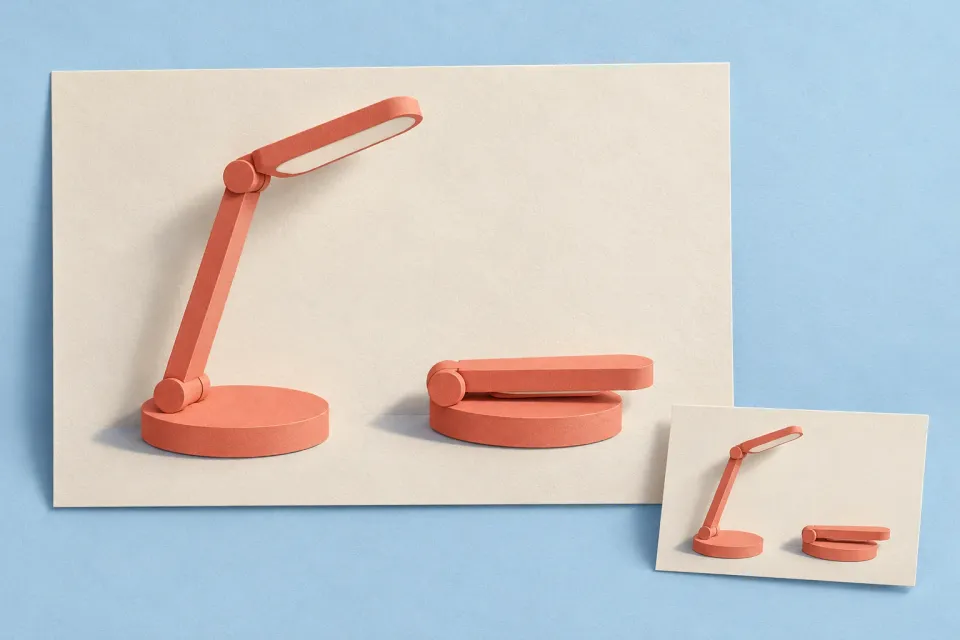
An image can look perfectly sharp while failing to communicate anything useful at a small size. A hinge becomes a dot, a software screen becomes a grid, or a product comparison becomes two apparently identical objects. Reviewing ChatGPT ad images requires a question about meaning as well as a question about image quality.
The purpose of this exercise is to discover whether the concept depends on detail that survives only in the designer’s working file. It is an editorial quality check, not a prediction of attention, clicks or commercial performance. Conduct it before polishing a concept whose essential explanation cannot fit comfortably into a small view.
Define the one thing the image must communicate
Choose one primary meaning that the image needs to carry. It might show how a bag opens, how a product fits into storage or what a particular service produces. “Everything that makes our product good” cannot become a useful comprehension test.
Consider a fictional company advertising a folding work lamp. Its intended customer works at a kitchen table and needs to put the lamp away afterwards. A beautiful picture of the lamp on a desk may communicate lighting without communicating storage.
Write the review question before showing the image: “Can someone understand that this lamp folds into a smaller object?” This gives the exercise a clear purpose. It also helps distinguish essential details from decoration that can disappear without damaging the concept.
Do not prompt the reviewer with the answer. Asking “Can you see that it folds?” encourages agreement. Asking “What does this image show?” reveals whether the folding idea is present without an explanation.
Create a viewing sample with honest limits
Use the preview available in your workflow and, where useful, add smaller internal samples. Label manually constructed frames as working examples. A phone-shaped mockup is not evidence of an official placement format or a faithful representation of every device.
Previews show appearance without establishing serving eligibility. OpenAI: Campaign Management Keep the visual review focused on its job and handle campaign status separately.
Small views also matter when a plan includes web delivery. OpenAI’s web platform group includes mobile and desktop browsers. OpenAI: Targeting “Web” should not become an assumption that every viewer has a large monitor.
View the sample at an ordinary distance and without zooming in to rescue a detail. If someone has to explain the design aloud, record that explanation as a possible missing piece of the concept. Do not quietly give the reviewer information that the ad itself does not provide.
Read the material three different ways
First, show the image on its own to someone outside the design discussion. Ask them to describe it and record their words. In the lamp example, “two different lamps” is a useful response even if the designer intended “one lamp in two positions”.
Second, show the complete ad with the proposed title and body. The elements should help each other. The copy may describe convenient storage while the image demonstrates the folded shape. That is different from using text to correct a misleading image.
Third, inspect the details that must remain accurate. Check that the product variant is correct, that the pictured accessories are included if the ad implies they are, and that any illustrative simplification preserves the product’s meaning. This careful reading has a different purpose from the initial recognition exercise.
The same person does not need to conduct every stage. Someone familiar with the product may catch an inaccurate feature while a colleague unfamiliar with it may reveal a confusing visual explanation.
Distinguish lost decoration from lost meaning
Some detail will disappear as an image becomes smaller. That alone is not a failure. The decision depends on what the missing detail was doing.
| Detail in the fictional lamp concept | Consequence when lost | Editorial decision |
|---|---|---|
| Decorative texture on the base | The use remains understandable | Accept the loss |
| Direction of the hinge | The folding movement becomes unclear | Simplify or change the viewpoint |
| Difference between open and folded positions | The image appears to show two models | Revise the composition |
| A small measurement label | The number cannot be read | Move the fact into suitable text or the destination |
This table is a way to prioritise edits. It does not prescribe image dimensions or promise how a particular interface will render a file.
A useful question is whether the image still communicates the same proposition after detail disappears. Losing an ornament is often acceptable. Losing the feature that distinguishes the advertised use case requires a new treatment.
Which missing detail changes the meaning?
- Texture disappears
The folding action remains clear. Accept.
Checkpoint - Hinge disappears
The movement becomes unclear. Try another viewpoint.
Reconsider - Two positions become two models
The reader misinterprets the comparison. Revise the visual idea.
Reconsider
Repair one cause before changing everything
Choose the most consequential misunderstanding and make a focused revision. For the lamp, first try a viewpoint that makes the folding relationship clearer. If the team simultaneously changes the background, product colour, headline and visual idea, it becomes harder to understand what resolved the confusion. If an essential detail blends into its surroundings, review contrast around the subject, text and markers before changing its size.
Making everything larger is not automatically the answer. A larger product may improve recognition but remove the setting that explains its use. Enlarging a numerical claim may make an unsupported statement more prominent. Improve comprehension without introducing a different content problem.
Use actionable review comments to record what disappeared, which meaning was lost and what the next sample should establish. This keeps the next designer from having to infer the reason behind each revision.
Set a clear acceptance condition
Approve the concept when its important meaning survives the small view, the copy supports the same offer and no indispensable detail requires zooming. If the image still depends on an explanation, consider a different concept rather than an endless sequence of cosmetic adjustments.
Save the reviewed version and the conditions of the exercise. Describe the internal sample used and what an unfamiliar reader understood. “The image passed our small-view comprehension check” is more accurate than a broad statement that the entire mobile journey has been tested.
Carry that record into final concept selection, then complete the wider preflight review. The small-view exercise has done its job when it reveals which visual idea remains coherent after unnecessary detail falls away.
Sources and scope
Decide whether an image retains its essential meaning in a small view before selecting it for a ChatGPT ad.
Working methods and examples are editorial suggestions. Check current platform requirements and available features before implementation.