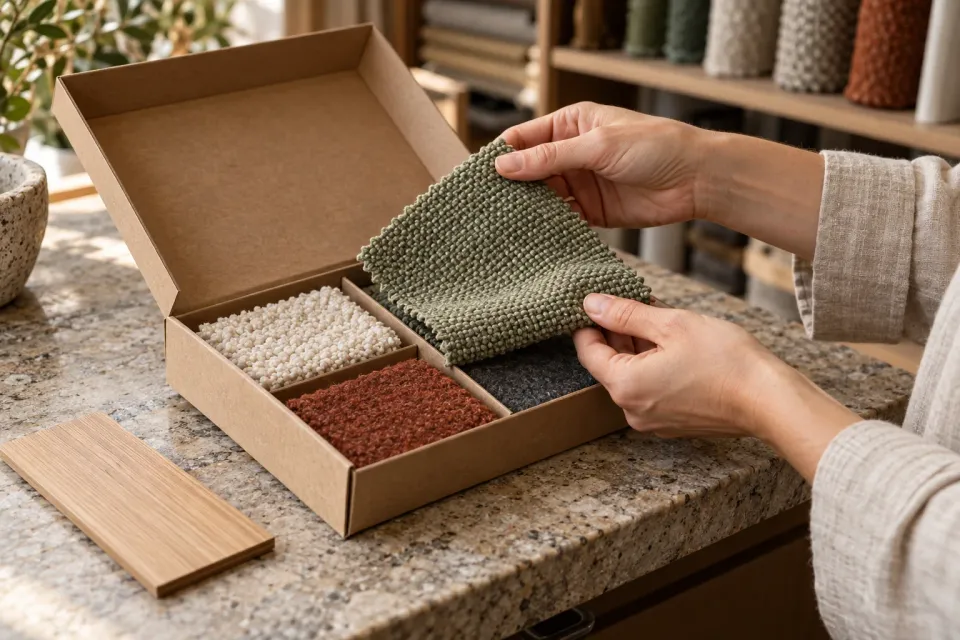
A buyer can understand an upholstery fabric’s product sheet and still want to hold it against the room’s existing colours. A material sample may then be a meaningful next step. The same piece of fabric does not automatically establish how comfortable a finished chair will be. Planning material samples in ChatGPT ads starts with a question: which uncertainty should the sample help the buyer examine?
This guide uses a fictional supplier of upholstery fabric for business premises. It offers sample pieces from selected existing collections. We assume no particular durability figures, charges or delivery times. The task concerns how the sample offer is described in an ad on ChatGPT, rather than the design of the journey after the click.
Start with the buying question, not the sample box
Write down what the buyer is deciding before choosing a sample pack. They might want to see whether a colour fits an existing carpet, feel the surface texture or choose alternatives to discuss with colleagues. These questions can give a sample a clear purpose.
Other questions require other evidence. How upholstery works on a particular chair also depends on construction and execution. Whether a material meets a specified requirement needs appropriate documentation. Do not assign the sample decisions that cannot be settled by looking at or touching it.
Express the question in everyday language: “We need to compare the current colours in the room.” That provides a more precise campaign starting point than “Professional buyers want quality”. The latter may describe a general preference, but does not explain why someone should request this sample.
Establish what the sample represents
A sample may represent a colour, a texture, a material or a combination. Verify which description the supplier can support. A piece from one collection should not be presented as representing the full range when it covers only a limited selection.
Keep a clear connection between the sample and the advertised option: collection, variant and the attribute being examined. This is working material for the message. Buyers should not have to guess whether the small piece represents the same finish as the furniture in the ad image.
Also establish whether the sample is for initial guidance or serves as an agreed reference for a later order. Those are different offers. If the supplier provides only an initial opportunity to examine material, the ad should not suggest that the sample completes approval of the entire purchase.
Give the sample a bounded job
| Buyer’s question | What the sample contributes | What still needs deciding |
|---|---|---|
| Does the colour fit our existing room? | A chance to inspect the actual sample in that setting | Which variant the project ultimately selects |
| How does the texture feel? | Direct contact with the material represented | The experience of a finished piece of furniture |
| Which options should we discuss internally? | Shared physical references for selected variants | Colleagues’ priorities and final decision |
| Does it meet a particular functional requirement? | Identification of the material to investigate | Relevant evidence for that requirement |
This table helps define the offer; it does not promise that a sample will always be sufficient. A buyer may need more information afterwards. The sample still serves a purpose if it makes a particular comparison possible.
Avoid describing it as “everything you need to choose correctly”. Name the assessment it supports instead. “Compare selected fabric colours in your room” could be an appropriate direction if both the selection and availability have been verified. A focused invitation can be useful without claiming to finish the whole purchasing decision.
What can the fabric sample help assess?
- Colour in the room
View the actual sample beside existing colours.
Checkpoint - Surface texture
Feel the material represented by the identified sample.
Checkpoint - Finished seating comfort
A fabric piece does not show the chair construction or complete experience.
Reconsider - Specified functional requirement
Identify the material and check the requirement against appropriate evidence.
Determine what a sample request leads to
Map the offer before selecting an action phrase. Can buyers order a named pack directly, specify preferred variants or only enquire about available samples? Does the supplier need project information to select a relevant assortment?
“Order material samples” implies a different degree of certainty from “Ask about samples of these fabrics”. “Get a sample collection” may suggest the collection will be dispatched after the action. If requests are assessed first, reflect that in the wording. Use the call-to-action commitment guide to align the action with the expectation.
Verify conditions that change the offer, such as which collections are included and whether samples can be sent to the intended recipient. Do not call the sample free without support for the complete claim. Do not add a speed promise the supplier has not committed to delivering.
Make the sample’s role clear to colleagues
In a B2B purchase, the person requesting the sample may differ from the person selecting the material. Give the offer a description that can be passed along: what will arrive, which options it represents and which question it helps the group discuss.
“Sample pieces for comparing selected upholstery fabrics” provides a shared description. “Discover the future of the workplace” gives a colleague less guidance about what to examine. Use the multi-person B2B purchase guide when different roles bring different questions. The sample need not answer all of them at once.
The distinction also helps prevent the request being mistaken for approval. A colleague might ask for a piece to explore a colour without endorsing that colour for the project. The ad should make investigation available without implying a purchase decision has already been made.
Check that the image promises the same offer
A photograph of a complete chair can imply product trialling when the offer is a small fabric piece. Choose copy and imagery that make the sample’s scope understandable. Do not show an extensive material library if the request covers a limited selection.
Review the claims through the ad-copy evidence matrix. OpenAI describes context hints as supplementary information, not exact-match keywords. An ad preview shows appearance. Use it to check whether the sample’s scope is clear. The finished brief should explain why the sample is the next step: the buyer receives a defined material to examine before a bounded choice, while the remaining questions stay visible.
Sources and scope
Choose a material sample as the advertised next step when it can address a bounded B2B buying question, with clear limits on what it represents.
Working methods and examples are editorial suggestions. Check current platform requirements and available features before implementation.