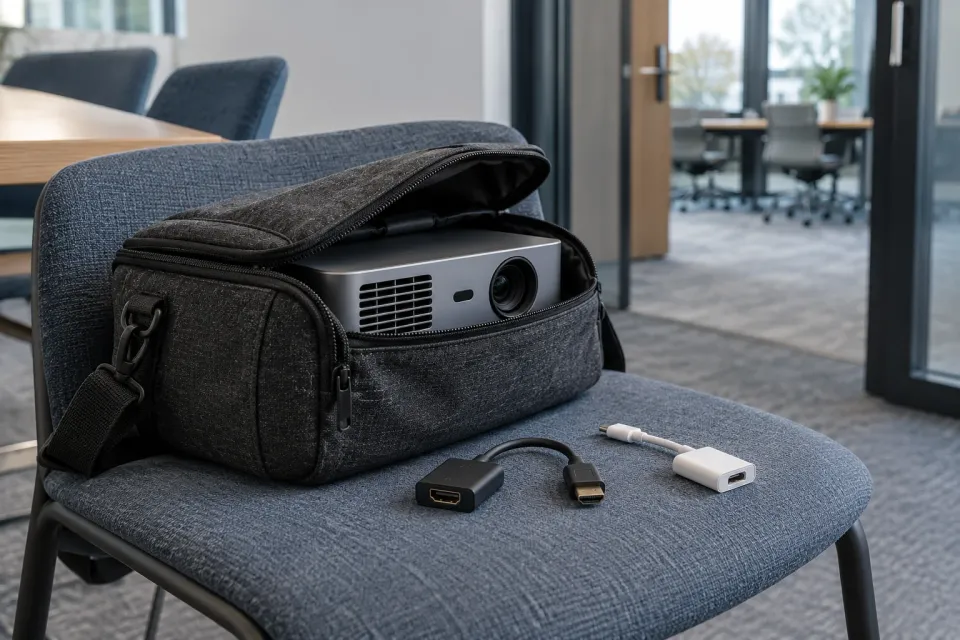
A review describing a product as “easy” provides little direction for an advertising brief. A review explaining how someone packs up equipment when moving between meeting rooms may reveal a concrete use case. Coding reviews by what the customer did, under which conditions and with what remaining difficulty makes that difference visible.
For a ChatGPT advertiser, coding is a research method. It should not automatically produce testimonials or rating-led ads. A published review is not, by itself, verified evidence of product performance. This guide uses an invented portable projector as its example. Every review-like phrase below is a fictional illustration.
Decide what the reading should establish
Choose a narrow question before collecting material. You might investigate the practical actions that determine whether equipment suits someone moving between meeting rooms. You would then look for transport, setup, connections and storage. You would not simultaneously try to infer the entire market, overall satisfaction and every possible product improvement.
Record where the material came from, when it was collected and which product version it concerns if that is known. Record the selection rule too, such as all available reviews from a defined period. If you only read reviews containing “adapter”, carry that limitation into the conclusion. Selecting only striking quotations afterwards makes it difficult to assess what the remaining material says. Keep source links or internal references so the interpretation can be reviewed. Avoid copying personal details or long passages when a factual summary is sufficient.
Label material about different products. A problem with an older model should not become an assumed property of the current offer. If the version is unclear, keep it unclear rather than letting the writer fill the gap.
Split the sentence before assigning codes
Consider this invented statement: “I carry it between meeting rooms; the bag works well, but I have to look for the right adapter.” It contains several observations. Movement describes the situation. The bag receives an evaluation. Searching for an adapter describes a difficulty that may depend on surrounding equipment.
| Fragment | Code | Useful follow-up question |
|---|---|---|
| Between meeting rooms | Repeated movement | What needs to travel with the device? |
| The bag works well | Positive evaluation of the bag | What works well about the bag? |
| Searching for an adapter | Connection obstacle | Which devices and connections needed to work together? |
This separation prevents “convenient to carry” from becoming “works immediately in every room”. The review does not support the latter claim. It may instead justify investigating which connections and accessories need a clearer explanation.
One review contains three kinds of information
- Situation
Moves the projector between rooms.
- Evaluation
The bag is considered useful.
- Condition
The right adapter still has to be found.
Reconsider
Keep the coding scheme small and adjustable
Begin with a few codes that answer the research question. For the projector, these might be moving, setting up, connecting and repacking. Give each code a short definition and an example. Two people should be able to understand what belongs in it.
Keep a place for relevant observations that do not fit. If several comments concern lending equipment to colleagues, that may be a distinct task rather than another transport comment. Record why the code list changed, and revisit earlier material when the change affects interpretation.
Compare a few coded passages with a colleague. Disagreement can reveal that “fast” refers to different things: setup, delivery or support. The sales-call language guide offers a related method for preserving the situation around a customer’s words.
Do not count comments as people or demand
A long review may repeat the same problem several times. One person may post in multiple places. Material from a particular product or channel may overrepresent especially positive or dissatisfied voices. State what you actually counted: passages, reviews or separate identifiable observations.
Do not turn that count into a forecast of how many people seek a solution on ChatGPT. Without other evidence, it describes the material you read. A single contradictory observation can still matter if it identifies a condition that changes the accuracy of the offer.
When useful, compare the finding with classified support questions. If the same connection obstacle appears there, you have a reason to investigate further. Two types of source still do not make every customer evaluation a technical fact.
Write a research note before writing an ad
A useful note might say: “In the reviewed material, movement between rooms appears alongside accessory questions.” Then add the fact that requires checking: which components belong to the advertised offer, and which must the customer provide?
Only then choose a possible ad task, such as explaining the equipment package. Use the claim evidence matrix for the product statement itself. A positive review of a bag cannot independently support a promise of trouble-free presentations.
If observations inform context hints, use them to describe relevant use cases. OpenAI’s targeting guidance, checked on 29 September 2026, describes hints as supplementary information within an ad group. They are not exact-match keywords and do not guarantee ad delivery. Do not treat negative review comments as negative keywords or blocking instructions in a hint either. Geographic, platform and audience restrictions belong in the campaign’s targeting settings.
Keep the code list, relevant source material, strongest contradiction and next verification question together. Another writer should be able to see why a use case was chosen and where interpretation ends. This provides a more useful foundation than a collection of positive adjectives detached from the situations that gave them meaning.
Use the coded situations as one input to audience and ad-content planning.
Sources and scope
Code reviews into traceable observations about customer tasks and language while keeping them separate from verified advertising claims.
Working methods and examples are editorial suggestions. Check current platform requirements and available features before implementation.