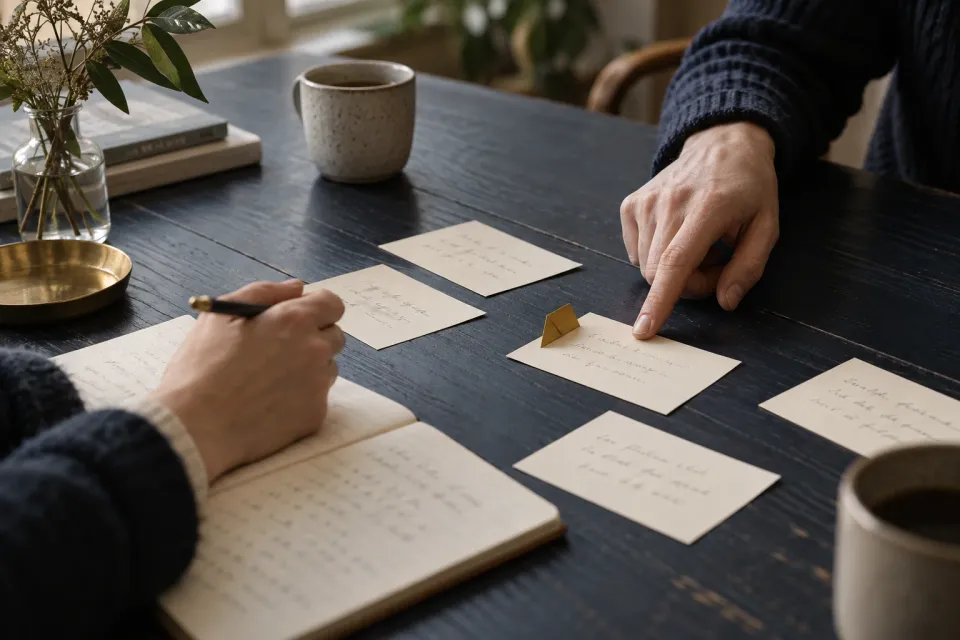
A customer interview is useful for advertising when it explains a real decision. A list of favourite brands or broad interests tells you much less than the sequence that led someone to seek help, compare alternatives and choose an offer. Before writing ChatGPT ads, interview for that sequence. You are looking for language and constraints you can substantiate, not a persona that sounds plausible in a presentation.
The method below is an editorial recommendation for conducting an interview and recording its answers. It does not predict which conversations will display an ad. OpenAI describes context hints as supplementary context, rather than exact-match keywords. Keep that distinction when turning interview material into campaign ideas. Official targeting documentation
Recruit around a decision, not a demographic
Choose an actual buying situation you want to understand. In this article’s fictional example, a company selling room-booking software recruits someone who recently replaced a shared calendar. Someone who merely likes workplace technology would answer a different question. The recent buyer has experienced the inconvenience, discussed a change and discovered what made a replacement difficult.
Include variation that matters to the decision. A first-time buyer and a person replacing an existing tool may use the same product but need different reassurance. Record which situation each participant represents. Avoid pooling their answers into one imaginary average customer.
Tell participants what the interview is for. Ask permission before recording, and keep personal details out of the working advertising brief. You need the decision pattern, not identifiable excerpts from a private conversation. A research note is not permission to publish a testimonial.
Use a sequence of concrete questions
Start with a specific event: “Think back to the last time you arranged a replacement for your booking system.” Then walk through what happened. These prompts help you stay close to remembered actions:
| Stage | Question | Useful follow-up |
|---|---|---|
| Trigger | What happened that made the old arrangement difficult? | Can you describe a particular occasion? |
| First response | What did you try before looking for a supplier? | What worked, and what remained unresolved? |
| Search | Where did you first look for possible approaches? | What words did you use to explain the problem? |
| Comparison | What made an option worth considering? | Which requirement could you not compromise on? |
| Doubt | What nearly stopped you moving forward? | How did you resolve that concern? |
| Decision | What happened immediately before you chose? | Who else needed to agree? |
Use follow-ups selectively. Reading every question like a form can interrupt a useful account. If a participant says that nobody trusted the calendar, ask what “trusted” meant. Was information out of date, were bookings overwritten, or was ownership unclear? Each explanation suggests a different advertising message.
Avoid asking the customer to write your strategy
“Would this headline make you click?” is a weak substitute for understanding the underlying need. A participant can offer an opinion without behaving that way later. Similarly, “Would you prefer a simpler tool?” invites agreement while leaving “simpler” undefined.
Ask instead for the task that felt difficult. In the booking example, a participant may describe having to check three calendars before confirming a room. That observation supports a hypothesis about consolidated information. It does not support a claim that your software will save every customer a specific number of hours.
Keep a separate column for interviewer interpretation. “Checks several calendars” is an observation if the participant reported it. “Needs a single workplace platform” is your inference. Preserving the distinction stops a reasonable guess from becoming an unsupported claim in the finished ad.
Probe a gap without supplying the answer
When a participant cannot remember, avoid supplying a plausible explanation. Ask which part they do recall: “Do you remember comparing alternatives, or also how you first found them?” Record the difference. An uncertain answer does not become more reliable because the interviewer repeats the question with additional options.
If useful, invite the participant to describe something they already had when deciding, such as a requirements list or a meeting date. They can explain what it contained without sharing the document. This can help separate an original requirement from something discovered after purchase. Mark which details are recollections and which could be checked.
Close by playing back your understanding: “I understood that you wanted to confirm room availability before inviting guests. What have I missed?” This leaves room for correction. Merely asking the participant to agree with a polished statement is a weaker check of your interpretation.
Three checks during the customer interview
- Ask about the event
What happened when two teams arrived at the same room? Ask for a concrete account.
- Check the recollection
Separate what the participant remembers from details that can be checked against records from that time.
Checkpoint - Invite a correction
Play back your understanding and ask what you missed before handing over the notes.
Checkpoint
Write up the interview while details are fresh
After each interview, write a short record while the details remain clear. Use the participant’s decision context, trigger, requirement, objection and resolution. Add the date and a reference back to the original notes. Quote only where wording is necessary, and mark paraphrases clearly.
Here is a fictional example:
| Evidence field | Research note |
|---|---|
| Situation | Office coordinator replacing a shared room calendar |
| Trigger | Two teams arrived for the same room |
| Requirement | Colleagues need to see availability before inviting guests |
| Concern | Existing recurring meetings must survive the change |
| Message hypothesis | Make room availability easier to check before booking |
| Product check | Verify the actual availability view and migration process |
The final two rows are work for your team. They are not conclusions the interview has already proved. If your offer does not address the requirement, do not force the participant’s language into an ad. The research may be telling you that this is the wrong situation to pursue.
Decide what the next interview needs to answer
Review the record before recruiting the next participant. If it lacks an account of what the customer actually did, you need a follow-up about that action. If you have a clear account from a first-time buyer but none from a replacement buyer, the gap is a different buying situation. More general opinions will resolve neither problem.
When the triggering event remains unclear, arrange the answers with a buying-trigger timeline. That guide analyses sequence after the conversation; these interview questions help you collect what the participant can recall. Do not convert uncertainty into an exact date just to complete a table.
A small set of conversations can provide useful questions and language without showing market size. Use the small-sample research guide when deciding how far your conclusions reach. Name the buying situation that remains missing from the evidence.
Hand over observations, interpretations and open questions together. The interview-to-message process then takes over. This interview is complete when another person can understand what the participant did and what remains uncertain. Approving an advertising statement is a subsequent decision.
Interviews are one part of preparation. The targeting and relevance overview connects this research with other planning decisions once the customer situation is understood.
Sources and scope
How to investigate an actual buying decision before using it in a ChatGPT ad brief.
Working methods and examples are editorial suggestions. Check current platform requirements and available features before implementation.